
Stalk, Campus MovieFest 2010
 The film starts with a cut-in shot of an empty jar and the pace is immediately set by jump cuts of a female adding bread, peanut butter, brown letter and a pen into the shot; it is not known at this stage but these items become symbolic in the film showing a constant routine of the character and the passage of time. The jump cuts then continue as she puts a pebble into the empty jar, triggering the major toned music which strangely gives positive connotations, for the story of the film this doesn't really give a happy theme to the setting but rather a strange tone that gives off a delusional image, similar to the personality of the main character. The same song is played throughout. The character then writes the day on the brown bag, places a peanut butter sandwich into it and then leaves the house; this routine seems planned and so it is implied that she has been doing this for some time, all the time the jump cuts are often used to show the strangeness of the character. The main bulk of the shots in this part are close ups and mid shots set from eye level to high angle; This shows a neutral eye level view throughout this part of the short film.
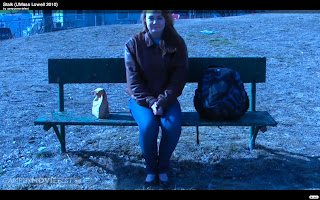 The next scene is where the plot begins to unfold, it depicts the female character sitting on a bench and watching the male character who she is "stalking" avoid a hole filled with pebbles and then takes a picture when his back is turned. She then takes a pebble from the hole and puts it in the jar that was empty in the first scene. This plot line makes the audience think what is going on because it is unclear as to why she is doing this. The characters confidence in doing this could also indicate that the storyline has gone on before the film even began, her body language and frequent smiling shows this confidence. Her smiling doesn't give off a nice aura for this particular style of film but instead gives a creepy aura which fits in well with the "stalker" theme. The thing that changes in this scene is it's all shot from one shot, a long shot of a park bench looking in on what's going on. This makes the audience believe that they are actually stalking the character because there is little camera movement it is in a fixed spot.
The next sequence mirrors that of the first scene giving it a sense of routine because she is doing the exactly same thing again, the audience know it is not the exact same twice because the character writes Tuesday rather than Monday so it is implied that a day has gone by since we last saw the character. A certain part of editing starting at 1:17 is used to shorten the time on the screen but it is the same time as last time for the main character. The editing used is where they split several shots onto the same screen in a split screen fashion, creating parallel timeframes, this keeps the viewer ensnared into the film, similar to that of the main character being ensnared to the person she is stalking, because there is so much happening on the screen at once. She then repeats the same as Mondays scene by sitting on the park bench, watching the male step over the pebbles, taking a picture, then taking a pebble, all the time with the same smile that shows she is strangely getting pleasure from what she is doing.
This short film was made for a movie festival hosted in the United States. Although the film quality isn't as up to scratch as most short films I believe the theme and several of the shots used could be beneficial to revise for use in our film. It depicts a young female character, probably in her late teens, depicting stalker like behaviour towards a male character at a park, the film plot is odd and has little sense until it begins to repeat and shows a sense of routine.
The film starts with a cut-in shot of an empty jar and the pace is immediately set by jump cuts of a female adding bread, peanut butter, brown letter and a pen into the shot; it is not known at this stage but these items become symbolic in the film showing a constant routine of the character and the passage of time. The jump cuts then continue as she puts a pebble into the empty jar, triggering the major toned music which strangely gives positive connotations, for the story of the film this doesn't really give a happy theme to the setting but rather a strange tone that gives off a delusional image, similar to the personality of the main character. The same song is played throughout. The character then writes the day on the brown bag, places a peanut butter sandwich into it and then leaves the house; this routine seems planned and so it is implied that she has been doing this for some time, all the time the jump cuts are often used to show the strangeness of the character. The main bulk of the shots in this part are close ups and mid shots set from eye level to high angle; This shows a neutral eye level view throughout this part of the short film.The next scene is where the plot begins to unfold, it depicts the female character sitting on a bench and watching the male character who she is "stalking" avoid a hole filled with pebbles and then takes a picture when his back is turned. She then takes a pebble from the hole and puts it in the jar that was empty in the first scene. This plot line makes the audience think what is going on because it is unclear as to why she is doing this. The characters confidence in doing this could also indicate that the storyline has gone on before the film even began, her body language and frequent smiling shows this confidence. Her smiling doesn't give off a nice aura for this particular style of film but instead gives a creepy aura which fits in well with the "stalker" theme. The thing that changes in this scene is it's all shot from one shot, a long shot of a park bench looking in on what's going on. This makes the audience believe that they are actually stalking the character because there is little camera movement it is in a fixed spot.The next sequence mirrors that of
the first scene giving it a sense of routine because she is doing the exactly same thing again, the audience know it is not the exact same twice because the character writes Tuesday rather than Monday so it is implied that a day has gone by since we last saw the character. A certain part of editing starting at 1:17 is used to shorten the time on the screen but it is the same time as last time for the main character. The editing used is where they split several shots onto the same screen in a split screen fashion, creating parallel timeframes, this keeps the viewer ensnared into the film, similar to that of the main character being ensnared to the person she is stalking, because there is so much happening on the screen at once. She then repeats the same as Mondays scene by sitting on the park bench, watching the male step over the pebbles, taking a picture, then taking a pebble, all the time with the same smile that shows she is strangely getting pleasure from what she is doing.


